


EmailMarketingZone.es · April 2026 · 9 min read
Imagine waking up on a Tuesday morning, making your coffee, and checking your phone — not to see how many people ignored yesterday’s campaign, but to discover that three strangers who found your website at 2am last night are already partway through a sequence you wrote once, three months ago, that is quietly guiding them toward becoming customers. No manual effort on your part. No follow-up emails you remembered to send. No leads slipping through the gaps because you got busy.
That is what a well-built email funnel feels like from the inside. And the word that stops most people from building one — the word that makes it sound complicated, technical, reserved for businesses with dedicated marketing teams — is the word «funnel.» Strip that away, and what you actually have is something beautifully simple: a sequence of emails, sent in the right order, at the right time, to guide a person from «curious stranger» to «paying customer» to «loyal advocate.»
You do not need to be a developer to build one. You do not need an expensive platform or a marketing degree. You need a clear understanding of four stages, a handful of well-crafted emails, and the decision to actually start. Here is exactly how.
«An email funnel is not a complicated machine. It is a conversation with a stranger — designed thoughtfully, delivered automatically, and built to earn trust before it ever asks for anything in return.»
What an Email Funnel Actually Is
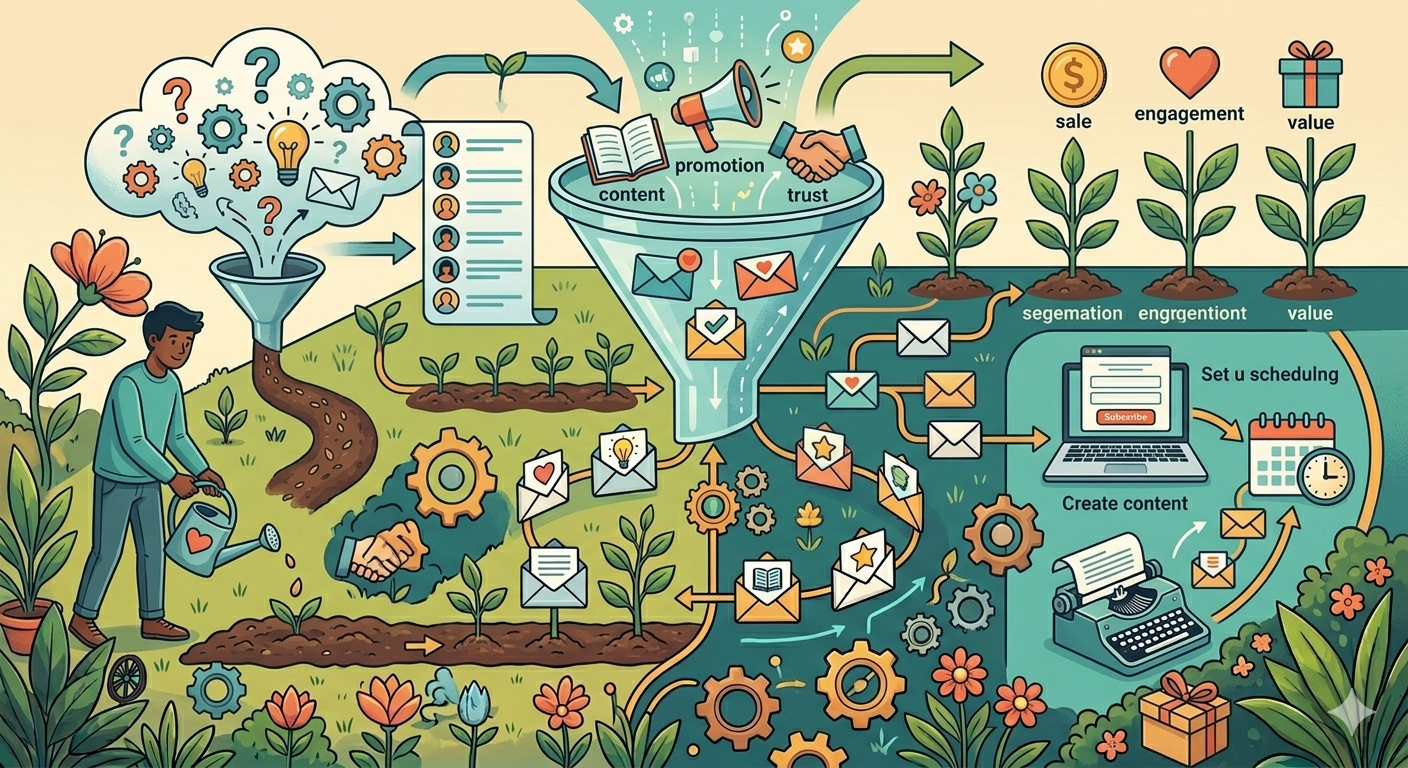
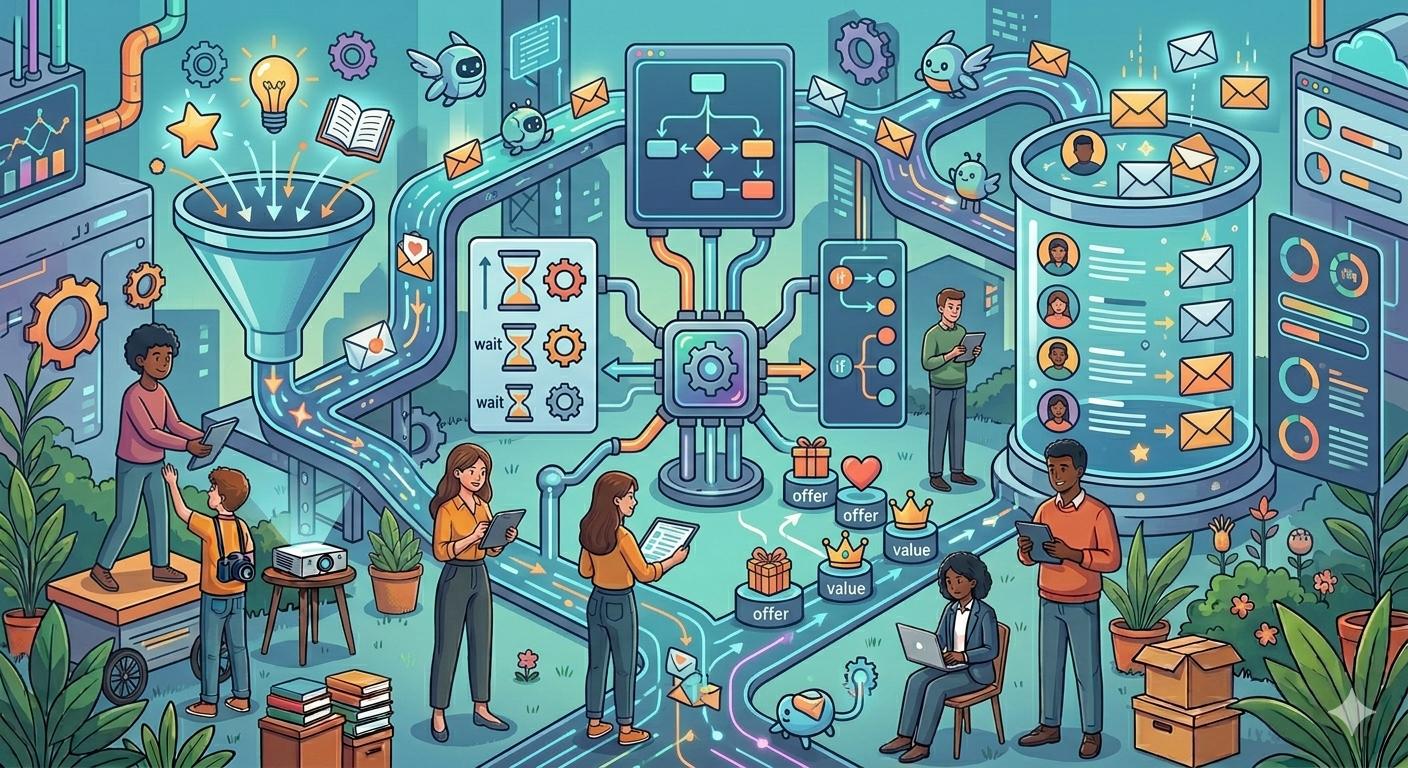
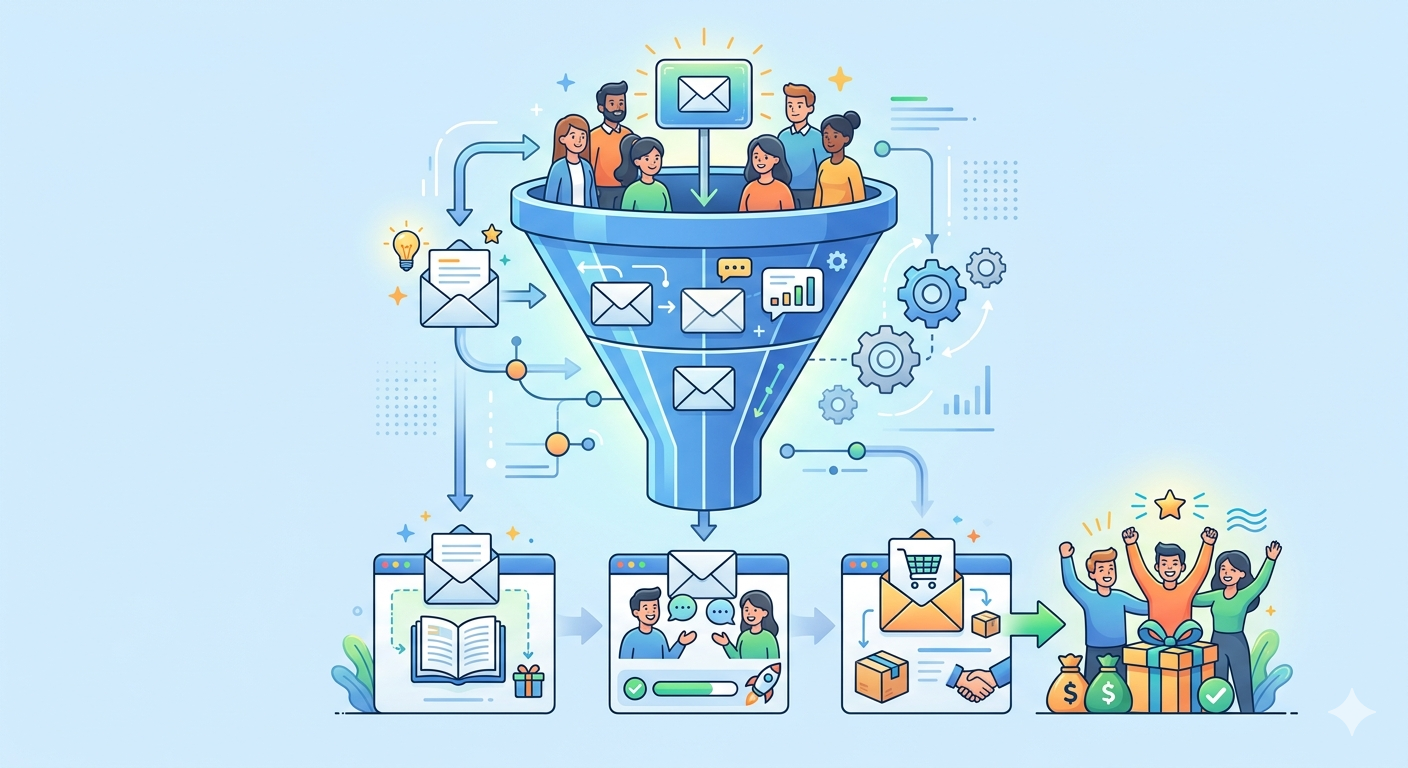
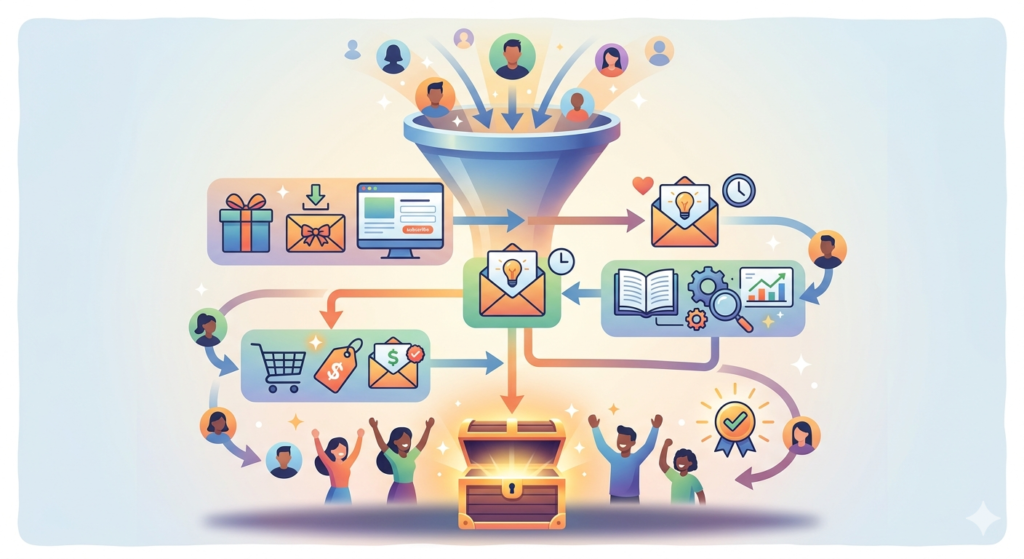
An email funnel is a series of automated emails triggered by a subscriber’s actions — signing up, clicking a link, making a purchase, going quiet — that moves them progressively from initial awareness of your brand toward a specific outcome you have decided on in advance. That outcome might be a product purchase, a service booking, a trial sign-up, or simply the transformation of a passive reader into an engaged community member.
The word «funnel» comes from the shape of the journey: many people enter at the top, fewer reach the middle, and the most engaged and committed arrive at the bottom. At every stage, the emails they receive should be precisely matched to where they are in their relationship with your brand — not too pushy, not too passive, and never irrelevant.
🔵 AWARENESS — Strangers discover you
🟢 INTEREST — Subscribers learn to trust you
🟡 CONVERSION — Warm leads take action
🩷 LOYALTY — Customers become advocates
Stage 1 — Top of Funnel: Capture the Right People
Top of Funnel
The lead magnet and the landing page
Nobody hands over their email address for nothing. Every subscriber who enters your funnel was persuaded to do so by a promise — usually in the form of a lead magnet. A lead magnet is a piece of immediately useful content: a checklist, a short guide, a free template, a mini course, a resource list. The key word is immediately. It must deliver genuine value the instant it is received, before the subscriber has read a single email from your sequence.
Your landing page — the page where the signup happens — should do one job and do it brilliantly: communicate the specific value of your lead magnet in the fewest possible words, and ask for one thing only. An email address. Not a name, not a phone number, not a life story. Just an email. Every additional field you add reduces your conversion rate. Make the barrier as low as the value is high.
Good lead magnet examples: «The 5-Minute Email Audit Checklist,» «Free welcome email template that converts,» «The beginner’s guide to email automation in 2026.»
Stage 2 — Middle of Funnel: Build Trust Before You Sell
Middle of Funnel
The welcome sequence — your most important emails
The moment someone joins your list is the peak of their curiosity and their trust in you. That window — the first 15 minutes after subscription, the first few days — is the highest-engagement window you will ever have with any subscriber. Do not waste it with a single generic welcome email and then silence.
A simple, powerful welcome sequence for most businesses looks like this:
- Email 1 — Immediate: Deliver the lead magnet. Warm, personal, no hard sell. Make them immediately glad they gave you their email.
- Email 2 — Day 2: Tell your story. Who are you? Why does this matter? What do you believe that most people in your space do not? This is the email that turns a transaction into a relationship.
- Email 3 — Day 4: Share your single most useful piece of content — a guide, a case study, a lesson learned. Pure value, no ask.
- Email 4 — Day 6: Address the biggest objection or fear your audience has about the problem you solve. Show them you understand it deeply.
- Email 5 — Day 8: Introduce your offer — gently, naturally, as the obvious next step for someone who has found value in everything that came before.
Automated email flows generate 15% higher open rates and 152% higher click rates than standard broadcast campaigns — because the timing matches the subscriber’s actual interest level, not a schedule you chose arbitrarily.
Stage 3 — Bottom of Funnel: Ask for the Sale — Confidently
Bottom of Funnel
The conversion sequence
By the time a subscriber reaches the bottom of your funnel, they know who you are, they trust you, they have received real value from you repeatedly, and they have seen your offer presented as the natural next step rather than an unexpected sales pitch. This is the moment to ask clearly and confidently — because everything that came before has earned you the right to do so.
Bottom-of-funnel emails do several things effectively: they create gentle urgency without manufactured pressure, they use social proof — testimonials, case studies, real results from real customers — to reduce the fear of making the wrong decision, and they make the purchase or sign-up process feel effortless. One CTA per email. One clear next step. No competing distractions.
For subscribers who click but do not convert, a behavioral trigger can send a follow-up email specifically addressing the hesitation — offering an FAQ, a comparison, or simply an invitation to reply with any questions. This email, triggered by a click without a purchase, is one of the highest-converting messages in any well-built funnel.
Subscribers who have engaged with 3 or more emails in your sequence are dramatically more likely to convert than those who received only one. Patience in the nurture phase makes the conversion phase dramatically more effective.
Stage 4 — After the Sale: Turn Customers Into Champions
Post-Purchase
The retention and advocacy sequence
The funnel does not end at the sale. In many ways, the most valuable stage begins after it. A customer who has just paid you is at their highest moment of excitement and lowest moment of doubt — they need immediate reinforcement that they made the right decision. A warm, personal post-purchase email sequence does exactly that: it celebrates their decision, onboards them smoothly into the product or service experience, anticipates questions before they become problems, and begins building the loyalty that turns a one-time buyer into a repeat customer and eventually a vocal advocate.
This stage is where most businesses leave staggering amounts of money on the table. The best businesses treat it as the beginning of a relationship worth investing in — because the customer who buys twice is exponentially more valuable than the customer who buys once.
The most common funnel mistake: Building too many stages before you have validated the core journey. Start with five emails — one lead magnet delivery, two nurture emails, one conversion email, one post-purchase follow-up. Get that working. Then add complexity only where data tells you it is needed. A simple funnel that runs is infinitely more valuable than a complex one still being built.
The Tools You Need (And They Are Simpler Than You Think)
Building a basic email funnel requires remarkably little. A landing page — most email platforms include a builder for this. An email automation tool — MailerLite, Brevo, Moosend, and Kit all allow you to build a complete funnel sequence on plans that cost under $15 per month, or free for smaller lists. A lead magnet — a PDF, a checklist, a short guide created in Canva in an afternoon. And the emails themselves, which you write once, set to send automatically, and then refine over time as data reveals what is working.
The total setup time for a functional first funnel — if you have your lead magnet ready and your offer clear — is typically between four and eight hours. The funnel then runs continuously, working for your business every hour of every day, whether you are at your desk, on holiday, or asleep.
Reality check on results: Automated email flows — the kind that power a well-built funnel — make up just 2% of total email volume but generate 41% of total email revenue across the industry. That ratio is not a coincidence. It is the result of perfect timing, genuine relevance, and the compounding power of trust built deliberately over a carefully designed sequence.
Start Simple. Start Today.
The biggest mistake marketers make with email funnels is waiting until everything is perfect before they build one. They wait until the lead magnet is polished to flawlessness. They wait until they have ten emails planned instead of five. They wait until they understand every nuance of their platform’s automation builder. And while they wait, the subscribers who found them last week received nothing — no welcome, no value, no reason to stay — and quietly drifted away.
A simple funnel, built imperfectly and launched today, will outperform a perfect funnel still being planned next month. Every subscriber who enters your sequence from this point forward begins a journey that can end in a purchase, a loyal relationship, and a referral. Every subscriber who enters to silence is a missed connection that no amount of retroactive optimization can recover.
Your funnel does not need to be complicated. It needs to be honest, valuable, timely, and real. Build those five emails. Set them to send automatically. Watch what happens. Then make them better. That is the entire discipline — and it is available to every business willing to start.